



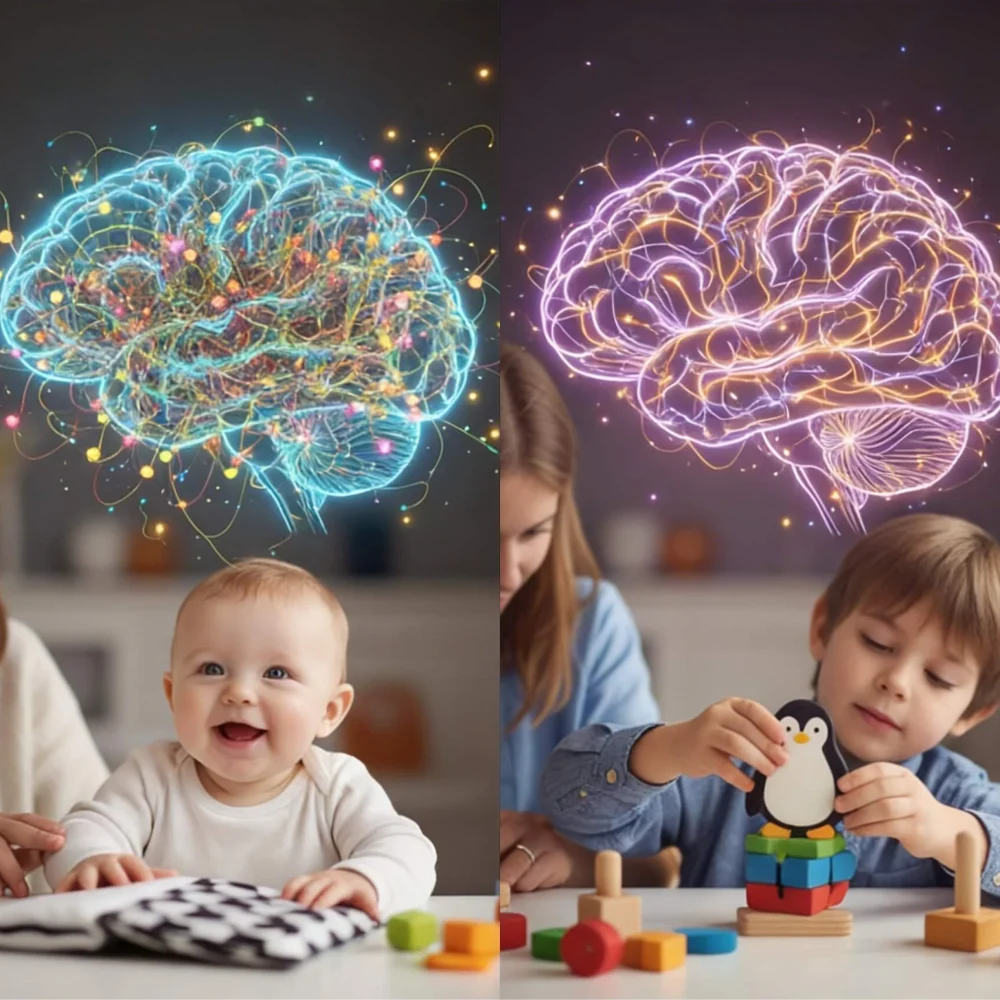
Hello, mom and dad!
Have you ever stopped to think about how your baby's brain, which at birth is a blank canvas, turns into such a powerful learning machine? One of the most fascinating secrets behind this development is a process called neural pruning. It sounds complex, but we promise it's simpler (and more incredible) than the name suggests. Let's unravel this process together and find out how you can help your child build a stronger, more efficient brain.
What is Neural Pruning?
Neural pruning is essentially “spring cleaning” for the brain. Imagine that, after birth, your baby's brain is like a garden where thousands of flowers and plants grow very quickly and densely. This is called synaptic explosion or synaptogenesis. The brain creates a huge number of connections between neurons (synapses) to prepare for all possible experiences.

However, not all of these connections will be useful. Neural pruning is the intelligent process in which the brain eliminates synaptic connections that are not used frequently, while strengthening those that are used more. It's the “use it or lose it” principle: the neural pathways that are stimulated by experience, learning and the environment are strengthened, and those that remain inactive are... pruned.
“What you're left with is a more restricted nervous system,” explains Jeff Lichtman, a Harvard neuroscientist. “But it's tuned exactly to the world you found yourself in.” This process does not weaken the brain; on the contrary, it makes it more efficient, specialized and faster, optimizing its circuits for the functions that are really important in the child's daily life.

When Does Neural Pruning Occur?
Neural pruning doesn't happen all at once. It occurs at several crucial stages of development, from infancy to early adulthood. The most significant are:
Human Brain Development Synapse formation is dependent on early experiences
- Sensory Pathways (Vision & Hearing)
- Language
- Higher Cognitive Functions
(Continuation of graph: Conception to Birth, Age in Months, Age in Years. Synapse formation begins declining before Age 3)
Caption: Graph showing the developmental peaks for different brain functions, such as sensory pathways, language and higher cognitive functions.
| Phase | Approximate age | Main Brain Area | Associated Development |
| First major pruning | 0-3 years | Sensory and motor cortex | Sensory development (vision, hearing), motor control and basic functions. |
| Second major pruning | 6-12 years | Areas of language and cognition | Consolidation of language, reasoning, social and emotional skills. |
| Third major pruning | 12-25 years | Prefrontal cortex | Decision-making, planning, impulse control and critical thinking. |
Source: Based on information from Healthline and PNAS.
First major pruning (0 to 3 years)
This is the most intense phase. Your baby's brain is absorbing the world around them. Every sound, every image, every touch and every taste is creating and strengthening connections. This is where the foundations for sight, hearing, language and movement are laid. The experiences you give your child are literally sculpting their brain.
Second Major Pruning (Starting at around 6 years old)
At this stage, pruning focuses on more complex areas such as language and cognition. Children begin to consolidate their school learning, develop their logical thinking and improve their social skills. The brain becomes more organized to deal with more abstract tasks.
Third major pruning (adolescence to 25 years)
Yes, you read that right! The brain continues to refine until the mid-20s. This last major pruning takes place mainly in the prefrontal cortex, our cerebral “CEO”. This is why teenagers can be more impulsive or have difficulty making complex decisions; their brains are still optimizing the connections responsible for planning and control.
How to Stimulate Your Child's Brain (0 to 5 years)
As parents, you have a fundamental role to play in helping to strengthen the right brain connections. The key is to provide an environment rich in positive stimuli and interactions. And the best way to do that is through play!
At Baby Kangaroo, we have a selection of toys designed exactly for these crucial stages. Here are some suggestions:
For the First Pruning (0 to 3 years)
At this stage, the focus is on sensory stimulation and motor development.
- Visual and tactile stimulation:
- High Contrast Fabric Book: Perfect for newborns, whose visual synapses are at the peak of development. The high contrast helps focus and strengthen vision.
- Sensory Activity Cube: With different textures, sounds and colors, it stimulates several areas of the brain at the same time.
- Fine and gross motor coordination:
- Silicone stacking cups: Stacking, fitting together and knocking down are actions that strengthen hand-eye coordination and the notion of cause and effect.
- Grabbing toy with rattle: Ideal for little hands to learn to grip, developing strength and dexterity.
For the Second Pruning (3 to 5 years)
As the child grows, the challenges can become more complex, focusing on problem-solving and the beginnings of logical thinking.
- Problem solving and reasoning:
- Penguin“ shape box: Recognizing shapes and finding the right place to fit them is an excellent exercise for the developing brain.
- Wooden Penguin Balancing Game: It helps develop concentration, patience and the first notions of physics and balance.
- Memory and Symbolic Play:
- Memory game with illustrations: Strengthens neural connections related to short-term memory and pattern recognition.
- Wooden tea set: Make-believe is crucial for social and emotional development, allowing children to experiment with different roles and scenarios.
Conclusion
Neural pruning is a natural and vital process that transforms your child's brain into an incredibly adaptable and efficient tool. It's not something to worry about, but a phenomenon to celebrate. Every hug, every song, every story you tell and every joke you share is helping to sculpt a masterpiece. Your love and attention are the most important nutrients for this brain garden. Keep providing a world of rich, positive experiences, and you'll be giving your child the best tool for a bright future.
References
[1] Cafasso, J. (2018). Synaptic Pruning: Definition, Early Childhood, and More. Healthline. [2] Sakai, J. (2020). Core Concept: How synaptic pruning shapes neural wiring during development and, possibly, in disease. PNAS.