
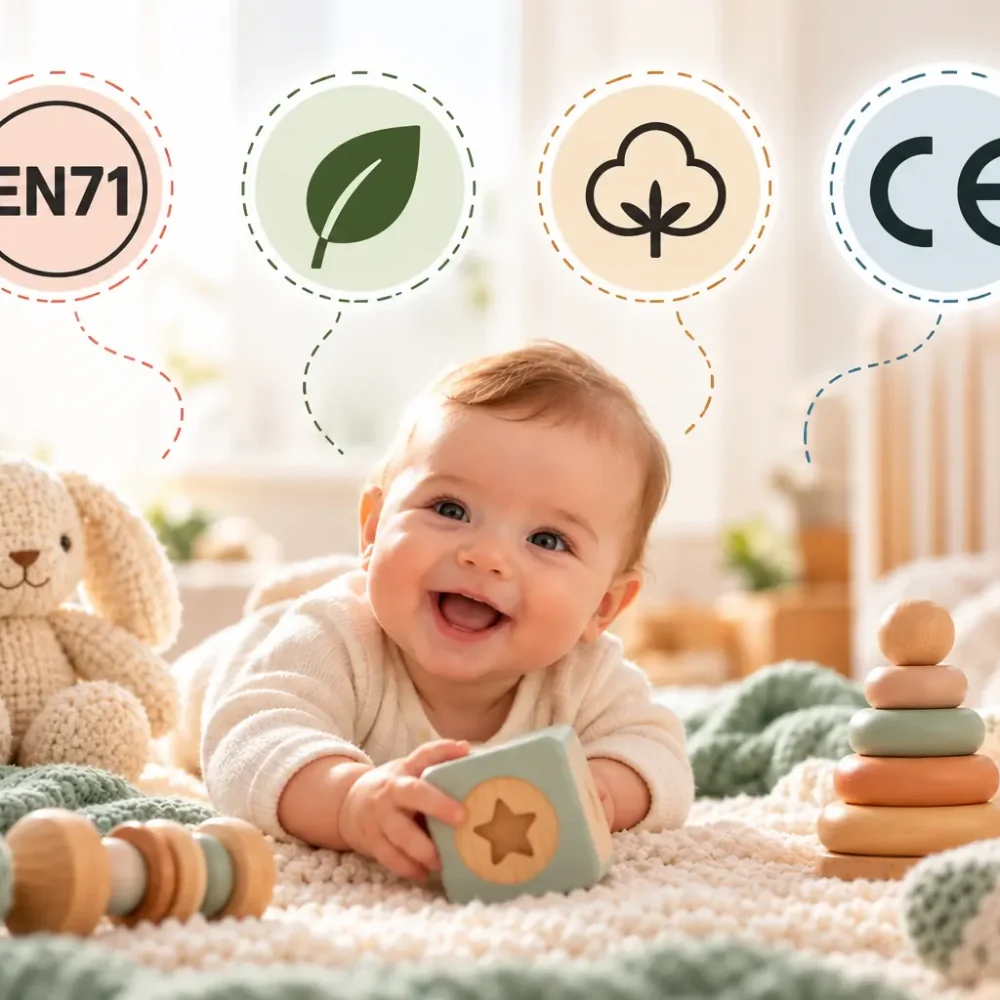
EN71, REACH, OEKO-TEX, CE: do you know what these certifications really guarantee about the safety of your baby's products? Find out how to identify them and why they make a difference.
Baby Safety Certifications: What EN71, REACH, OEKO-TEX, and CE Mean
When you buy a toy, an item of clothing, or a feeding utensil for your baby, you have probably already seen acronyms like EN71, REACH, CE or OEKO-TEX on some label or product sheet. But what do they really mean? And why is their absence one of the first red flags in products coming from platforms like Shein or Temu?
This guide explains, in simple terms, what each certification guarantees, what it tests, and how you can use it to choose truly safe products for your child.
Why Certifications Matter
A certification is not a decorative seal. It is proof that a product has been tested according to specific standards — mechanical, chemical, or flammability — before reaching a child's hands. As we saw in the article about the hidden risks in baby products from platforms like Shein and Temu, most of the non-compliant products tested on these platforms failed to meet precisely these standards.
Knowing these certifications allows you to do two things: identify genuinely safe products and recognize when a product listing doesn't say enough.
CE Marking: The Legal Basis in the European Union
The marking CE (Conformité Européenne) is mandatory for most toys and many other products sold in the EU. It indicates that the manufacturer declares, under its sole responsibility, that the product complies with the essential safety requirements of the applicable European legislation.
It is important to realize a limitation: the CE mark is self-declared by the manufacturer, it is not issued by an independent body after mandatory testing in all cases. Therefore, it should be viewed as a minimum legal requirement rather than an absolute guarantee — it is stronger when combined with other certifications and an identifiable, responsible European importer.
EN71: The European Toy Safety Standard
A EN71 it is the specific European harmonized standard for toys, divided into several parts:
- EN71-1 — Mechanical and physical properties (small parts, cutting edges, strength).
- EN71-2 — Flammability.
- EN71-3 — Migration of certain chemical elements (heavy metals such as lead and cadmium, among others).
An EN71-compliant toy was evaluated for these specific risks—precisely the types of failures identified in Euroconsumers tests on products from Shein and Temu.
REACH: European Chemicals Regulation
O REACH (Registration, Evaluation, Authorisation and Restriction of Chemicals) is the European regulation that controls the registration, evaluation, and restriction of chemical substances, including in consumer products. It restricts or bans substances such as phthalates, PFAS, and other chemicals associated with hormonal disorders and other health risks.
A REACH-compliant product should not contain these substances above the legal limits defined by the EU — the same limits that Greenpeace and CHEM Trust reports found systematically exceeded in Shein products.
OEKO-TEX Standard 100: Textile Safety
The certification OEKO-TEX Standard 100 applies to textiles — clothing, bedding, towels, cloths — and tests for the presence of harmful substances at all stages of production. It has four requirement classes, being the Class 1 the most rigorous one, reserved for items for babies and children up to 3 years old.
This is particularly relevant for textiles in direct and prolonged contact with a baby's skin, such as bodysuits, muslin cloths, or bedding.
Summary Table: What Each Certification Guarantees
| Certification | Applies to | What Guarantees |
|---|---|---|
| CE | Most products, incl. toys | Self-declared minimum legal compliance by the manufacturer |
| EN71 | Toys | Mechanical, physical, flammability, and chemical safety |
| REACH | All products with chemical components | Absence or legal limit of hazardous substances |
| OEKO-TEX Standard 100 | Textiles | Free of harmful substances, Class 1 for babies up to 3 years old |
How to Verify These Certifications Before Buying
At Baby Kangaroo, all products are European brands and comply with the certifications relevant to their category — REACH and EN71 for toys and utensils, GOTS and OEKO-TEX for textiles. You can confirm this information in our product datasheets toy categories, food, comfort and bath.
Frequently Asked Questions
Is the CE marking sufficient to guarantee that a toy is safe?
It is the minimum legal requirement, but because it is self-declared by the manufacturer itself, the ideal is to also look for EN71 and REACH compliance, in addition to an identifiable European importer responsible for the product.
How do I know if a product really has these certifications and is not just a claim?
Serious European brands make compliance information available on the product data sheet or upon request. The complete absence of this information, or anonymous sellers without an EU address, are red flags.
Do baby textiles need a different certification than toys?
Yes. Textiles are evaluated by standards such as OEKO-TEX Standard 100 or GOTS (for organic cotton), while toys follow EN71. They are distinct certifications for distinct risks.
Do you want products with these confirmed certifications?
Explore the Baby Kangaroo complete catalog - only certified European brands, designed for the safe development of your baby.