



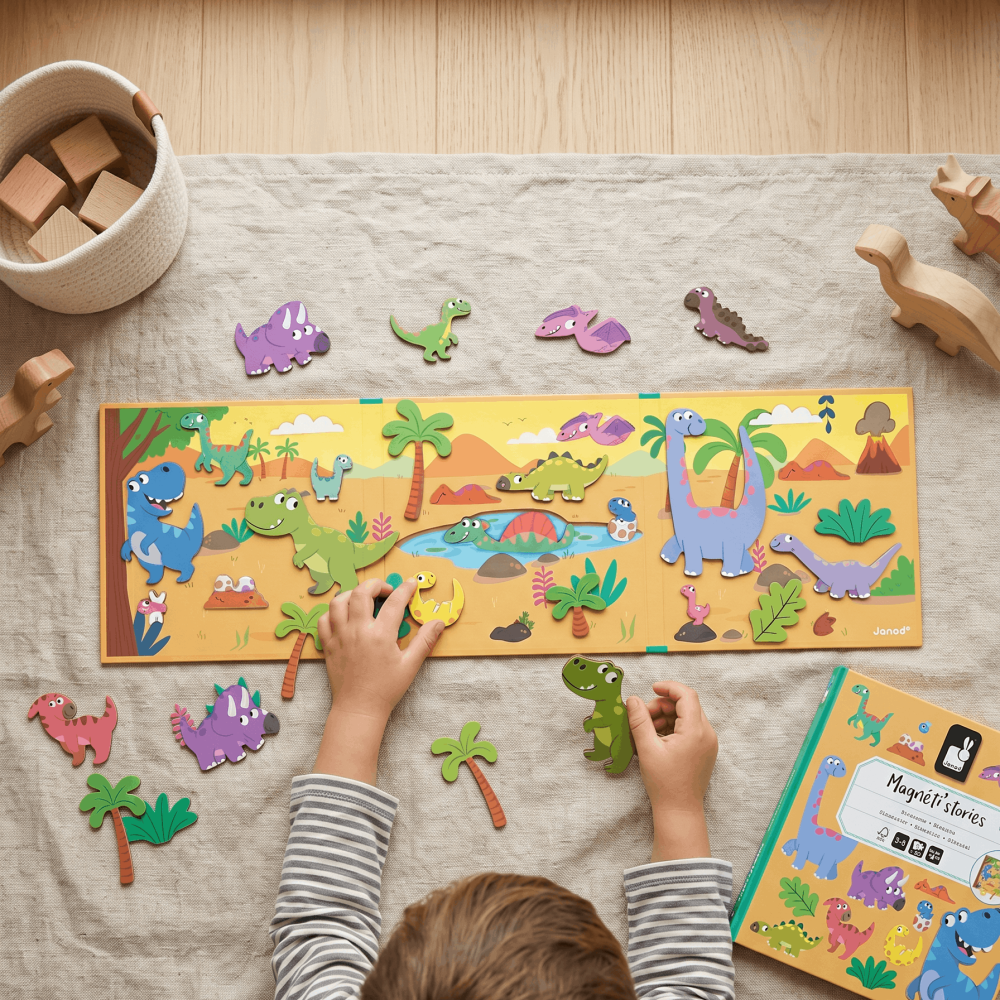
In the first year of life, a baby's brain develops at an extraordinary rate. New abilities emerge each week: focusing their gaze, grasping objects, rolling over, sitting up, crawling. And what most enhances this development is not a screen – it's the physical, sensory, and relational experiences that happen on the floor, in our arms, and during shared play.
Playing without a screen isn't a sacrifice. It's simply how babies learn best.
In this article, you'll find activities organized by stage, the types of toys that make a difference at each step, and practical tips to make playtime richer—without technology, without complications.
Why are screen-free activities so important in the first year?
The World Health Organization recommends zero screen time for babies under 18 to 24 months old. The reason is simple: a baby's brain needs physical and relational stimuli to develop. Touch, texture, real sounds, parents' faces – no screen can reproduce that richness comparably.
Studies in child neuroscience show that early sensory experiences literally shape neural connections. Every time a baby grips an object, hears a voice, or explores a new texture, they are building the brain architecture they will use throughout their lives.
Playing without a screen is, first and foremost, playing with the real world.
Best Screen-Free Activities by Stage: From Birth to First Birthday
0 to 3 months — Stimulate the most basic senses
In the first few months, vision is still developing. Babies focus better on black and white and at short distances (about 20–30 cm). Hearing, on the other hand, is already quite acute from birth.
Simple and effective activities:
- Face to face — Bring your face close and speak softly. It's the most powerful stimulus at this stage.
- High contrast cards — Black-and-white patterns capture visual attention and stimulate eye development.
- Music and voice — Singing, reciting rhymes, talking about what you are doing. The parents' voice regulates the baby's nervous system.
- Tummy time — Essential for strengthening the neck and preparing for future movements. Start with a few minutes and gradually increase.
Suitable toys: Lightweight rattles that are easy to grasp, high-contrast mobiles, soft silicone teethers. The first Montessori-inspired toys for this phase, they are precisely designed to accompany these emerging competencies.
3 to 6 months — Exploring with hands
At this stage, the baby begins to close their hand intentionally, bring objects to their mouth, and follow movements with their eyes. It's a time of active exploration through touch and taste.
Simple and effective activities:
- Texture basket Gather safe objects with different textures (a sponge, a piece of velvet, a muslin cloth, a smooth wooden object). Let the baby explore.
- Tummy time with a mirror — A baby-safe mirror encourages them to hold their head up for longer.
- Play with feet — Attaching a rattle to the baby's feet helps them understand the relationship between movement and consequence.
- Soap bubbles Simple, inexpensive, and absolutely fascinating to the eyes of a 4-5 month old baby.
Suitable toys: Toys with varied textures, easy-to-grip balls, silicone or natural rubber teethers. A Play mat With an arch, it's ideal for this stage: the baby lies down, looks at the hanging toys, and starts trying to reach for them — hand-eye coordination in its most natural form.
6 to 9 months — Movement, staying put, and imitation
Starting at 6 months, an important change happens: the baby begins to realize that objects exist even when they can't see them. Short-term memory is awakening. It's also the stage when many babies start to roll over, crawl, and prepare to creep.
Simple and effective activities:
- Hide-and-seek with objects — Hide a toy under a diaper and let the baby discover it. Repeat. This is the basis of object permanence.
- Explore space freely — Laying a rug on the floor and letting the baby move around freely is the best activity at this stage. Spontaneous movement is fundamental.
- Imitate sounds and expressions — The baby starts to babble and imitate. Respond to the sounds it makes, make simple gestures to imitate.
- Explore containers Giving the baby a box with objects to take out and put back in provides hours of occupation and cognitive development.
Suitable toys: Simple interlocking toys, wooden blocks, objects that make a sound when manipulated. The Montessori toys for this stage focus precisely on this cause-effect exploration without technology.
9 to 12 months — Autonomy, language, and nascent symbolic play
The baby is on the verge of standing up. Coordination is becoming more refined—they can pick up small objects with two fingers (pincer grasp). Language is exploding: they understand much more than they can say. And simple symbolic play is starting to emerge: feeding a doll, pretending to drink from an empty cup.
Simple and effective activities:
- Cloth or board books — Naming images, making animal sounds, pointing. Shared reading at this stage has a direct impact on language development.
- Stack and knock down — Stacks of blocks to enthusiastically knock down. Simple and incredibly satisfying for a 10-month-old baby.
- Exploration of nature — Leaves, smooth stones, sand, grass. Supervised, it's high-quality sensory stimulation.
- Music with featuring — Clap your hands, shake a rattle, bang a pot. Rhythm and active participation develop coordination and musicality.
Suitable toys: wooden blocks for stacking, simple inset puzzles, figures for pretend play. The Montessori toys for close to the first birthday help develop fine motor skills and autonomy in a very natural way.
The role of the gym and play mat in the first year
If there is a single product that is useful throughout practically the entire first year, it is the Baby gym or play mat.
In the first few months, it serves as a base for tummy time and for visual exploration of hanging toys. From 3-4 months, the baby begins to try to reach and grasp these toys – it's simple, pure eye-hand coordination. Later, it becomes the space where the baby rolls, sits, and explores freely.
When choosing a gym or mat, it's worth considering:
- Safe materials — GOTS, organic cotton, FSC wood. The baby will put everything in their mouth.
- Ease of washing Inevitable.
- Interchangeable toys — Allows you to renew interest without buying a new product.
- Screen-free philosophy adherence — Prefer gyms without LED lights or electronic sounds. The baby doesn't need special effects to feel stimulated.
Practical tips for screen-free play in everyday life
Quality over quantity. Fifteen minutes of active, present play is worth more than an hour of scattered toys while on the phone. The baby feels and responds to parental attention.
Floor routine. Establish the habit of having a safe space on the floor, with a rug and a few rotating toys. Fewer simultaneous stimuli = deeper exploration of each object.
Toy rotation. Instead of leaving all the toys available all the time, put half of them away. When you reintroduce them after two weeks, they will be “new” to the baby.
Nature is the best toy. From 6 months of age, regular outings where babies can touch grass, observe falling leaves, or listen to birds are high-quality, zero-cost sensory stimulation.
The screen as a tool for parents, not for babies. Watching a quick video on your phone while holding a baby isn't the same as letting an 8-month-old watch a tablet. The issue isn't perfection—it's awareness.
Frequently asked questions
From what age can a baby watch screens?
A OMS The American Academy of Pediatrics recommends avoiding screens until 18–24 months, with the exception of video calls with family. The reason is that a baby's brain at this stage learns primarily through physical interaction and human relationships, not through passive screen content.
Is it bad that my baby is entertained by a cell phone?
Isolated moments don't cause harm. The problem arises with frequent and prolonged use, which can replace active play and interaction with adults — both of which are essential for development. If the screen becomes the only way to “switch off” the baby, it's worth exploring alternatives like those described in this article.
Are Montessori toys really better?
The Montessori philosophy – natural materials, simplicity, and age-appropriateness – aligns well with scientific research on child development. It's not a brand or certification, but a principle: the right toy is one that supports what the baby can already do and helps them take the next step, without unnecessary special effects.
How many toys should a 6-month-old baby have?
Less than most parents think. Two or three age-appropriate toys, rotated, are enough. An abundance of toys does not stimulate more—on the contrary, it can scatter attention and reduce the exploration time for each toy.
Is tummy time mandatory?
It's highly recommended. In addition to strengthening the neck and shoulder muscles—essential for crawling and future posture—tummy time encourages babies to look at the world from a different angle. Start with 2–3 minutes several times a day and gradually increase. A padded mat or play gym makes this time more comfortable for your baby.