



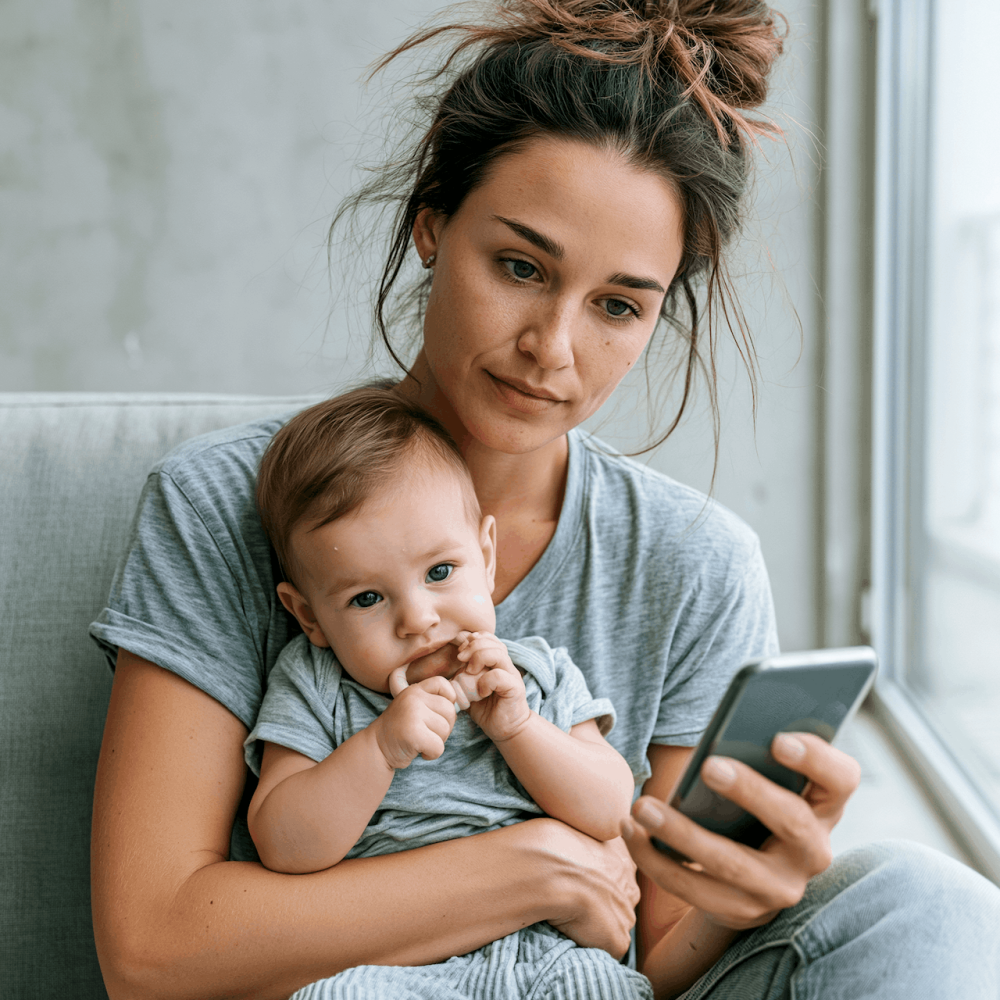
The mobile phone is everywhere. And when a baby cries at 11 PM and a video calms them down in two minutes, it's hard to resist. No judgment here.
But the question many parents end up asking — especially as the baby grows — is: How much is too much? And what does science actually say about screens at this stage of life?
This article answers these questions based on current recommendations from international health organizations and available scientific research. No alarm, no blame — just information for making informed decisions.
What the WHO and pediatricians say: recommendations by age
The main pediatric health entities — the World Health Organization (WHO), the American Academy of Pediatrics (AAP), and the Portuguese Society of Pediatrics (SPP) — are consistent in their recommendations:
- 0 to 18 months zero screen time, with the exception of video calls with family (grandparents, etc.).
- 18 to 24 months Educational content can be introduced in a limited way, always with adult supervision.
- 2 to 5 years: A maximum of one hour per day, with parental supervision and age-appropriate content.
The WHO goes further and recommends that babies under one year old spend as much time as possible on interactive floor-based physical activities – and that time in restraint devices (carrinhos) be limited to one hour at a time, without screen association.
These are more restrictive recommendations than many parents imagine. And they have good reason to be.
What happens in a baby's brain when they look at a screen?
A baby's brain in the first year of life is in a period of extraordinary plasticity. Neuronal connections form at a pace that will never be repeated. And what fuels them are not moving images—they are physical, relational, and sensory experiences: the faces of parents, the textures they touch, the sounds of the environment, the effort of grasping an object.
A screen offers visual and auditory stimulation, but in a unidirectional way. The baby does not respond, does not interact, does not learn from the consequences of their actions. In terms of development, it is passive stimulation at a stage when the baby urgently needs active stimulation.
Research in child neuroscience, referenced in Portuguese pediatric literature, associates excessive screen use in early childhood with delayed cognitive, language, and socioemotional development—largely because the presence of screens reduces parent-child interaction.
What does scientific research say: the concrete risks
In recent years, studies on this topic have accumulated. The most relevant results for the first year of life are:
Language Development
A study published in the JAMA Pediatrics, analyzed by Portuguese pediatric specialists, concluded that babies aged 1 year exposed to more than 4 hours of screen time daily are almost 5 times more likely to present communication delays at 2 years of age. The reason, according to pediatrician John Hutton of Cincinnati Children’s Hospital, is straightforward: children learn to speak when they are encouraged to speak. In front of a screen, they have no opportunity to practice.
Sleep
Exposure to blue light from screens suppresses melatonin production—the hormone that regulates sleep. In infants, whose sleep cycles are already naturally unstable, screen use at the end of the day is associated with greater difficulty falling asleep and poorer sleep quality. The Revista Portuguesa de Psiquiatria e Saúde Mental (Portuguese Journal of Psychiatry and Mental Health) published a letter to the editor in 2021 that specifically systematizes this association between screen time and sleep disturbance in young children.
Motor skills and physical development
The same study from JAMA Pediatrics found that babies with over 4 hours of daily screen time were also more likely to have delays in fine motor skills and personal and social skills at 2 years old. Screen time is, in practice, time without movement — and movement is essential at this stage.
Behavior and attention
Portuguese developmental psychologists, cited in publications of the Portuguese Society of Pediatrics, point to a possible association between excessive screen time and an increase in behavioral problems and attention disorders. The most plausible hypothesis: the fast pace of digital content conditions the baby's attention system to high-intensity stimuli, making it difficult to maintain focus on slower activities such as playing, listening to a story, or exploring an object.
Does the parent screen count?
This is a question that rarely appears on recommendation lists, but research is beginning to show: parents' screen time in the presence of the baby has an effect.
When an adult is engrossed in their phone, moments of eye contact, responsiveness to vocalizations, and spontaneous interaction with the baby decrease. And it is precisely these moments—small, frequent, seemingly trivial—that fuel language development and bonding.
It's not about blaming parents. It's about realizing that the issue of screens isn't just “how much time the baby is looking at a screen,” but also “how much time adults are actively present.”.
How to reduce screen time: practical strategies
Completely eliminating screens from a modern family's daily life isn't realistic for most people. The goal isn't perfection—it's awareness and gradually replacing them with alternatives the baby enjoys just as much, if not more.
1. Create screen-free zones and times
Establish routines where screens are simply absent: meal times, the 30 minutes before bed, floor play time. It's not a hard rule to follow—it's just a habit to build.
2. Replace screen time with simple physical activity
In most cases, the screen is used to entertain the baby while the adult needs to do something else. An effective alternative is to have a activity mat or gym in the corner of the playpen where the baby can explore independently and safely. It does not replace parental attention, but offers real stimulation without a screen.
3. Use toy rotation
A baby who has seen all available toys quickly loses interest, and the screen becomes the obvious alternative. Put away half of the toys and rotate them every week or two. The “old” toy becomes new again, and spontaneous interest lasts much longer. Montessori-inspired toys are particularly well-suited for this strategy: simple, long-lasting, and with enough depth of exploration to maintain interest over weeks.
4. Do not use the screen as a usual calming strategy
A one-time episode doesn't cause harm. The problem arises when the screen becomes the only resource for calming the baby. Other strategies—cuddles, live music, a walk, a pacifier, a teething toy—have the same immediate effect and don't create the screen-comfort association pattern that is later difficult to undo.
5. Video calls count differently
The WHO and AAP make an important distinction: video calls with family members are a reasonable exception even before 18 months. The reason is that they involve real interaction, responding to expressions and voice, and contact with familiar faces—nothing passive.
6. Go abroad regularly
The outdoors is the most effective antidote to screens. Daily walks—even short ones—expose babies to a sensory richness that no screen can replicate: natural light, varied sounds, air movement, and the textures of plants and surfaces. From 6 months onwards, letting babies touch grass, leaves, and sand under supervision provides top-quality stimulation.
What if my baby has already spent too much time with screens?
The plasticity of the child's brain works in both directions: it is sensitive to the negative effects of excessive screen use, but it is also highly responsive to change. Gradually reducing screen time and replacing it with active play, interaction, and physical exploration has a real effect — and it's never too late to start within the first year of life.
If you have specific concerns about your baby's development, the attending pediatrician is always the first resource to contact.
In summary: what to do with this information
The recommendations are clear: zero screens until 18 months, except for video calls. Research supports this recommendation with concrete data on language, sleep, motor skills, and behavior.
But the goal isn't to create guilt — it's to create alternatives. A baby who has access to floor play, frequent interaction with adults, and age-appropriate objects doesn't need screens to feel stimulated. They need exactly what they've always needed: presence, exploration, and time.
If you're looking for inspiration on what to do instead of screen time, read our article Baby Stimulation: The Best Screen-Free Activities from 0 to 12 Months.
Frequently asked questions
From what age can a baby watch screens?
The WHO and the American Academy of Pediatrics recommend zero screen time until 18 months of age, with the exception of video calls with family members. Between 18 and 24 months, educational content can be introduced in a limited way and always with adult supervision.
Watching television in the background is bad for the baby?
Yes, it can have a negative effect. Television in the background, even if the baby isn't directly looking at it, interferes with the quality of parent-child interaction, reduces baby vocalizations, and fragments the attention of both. Studies indicate a negative impact on language acquisition even in this “indirect” scenario.
Are educational applications an exception?
Not significantly. Most of the positive effects of “educational” apps lack robust scientific support for babies under 2. Babies do not easily transfer what they learn on a screen to the real world—the so-called “video deficit.” Learning at this stage happens fundamentally through physical and human interaction.
What if the baby is addicted to the screen? How to stop?
The word “addicted” is strong, but a pattern of dependency can set in quickly. The best approach is a gradual — not abrupt — weaning combined with the consistent introduction of interesting alternatives: floor time, walks, vocal interaction, rotating new toys. The transition is often easier than parents anticipate, especially under 12 months.
Should parents also avoid mobile phones in front of the baby?
Research suggests that yes, at least during moments of active interaction. Mobile phone use by the adult in the baby's presence reduces the frequency of eye contact, vocalization responses, and spontaneous interaction—all of which are essential for language development and bonding. It's not an absolute rule, but it's a factor to consider.