
When you start preparing for solid food introduction, you inevitably come across the acronym BPA on the packaging of dishes, cups, and pacifiers. “BPA Free,” “No BPA,” “Free from BPA” - it's everywhere. But what does it actually mean? Why all the fuss? And how can you know, in practice, if what you're buying is really safe for your baby?
In this article, we explain everything clearly, without unnecessary alarm, so you can make informed choices.
What is BPA?
BPA stands for Bisphenol A, an industrial chemical compound that has been widely used since the 1950s in the production of rigid plastics (specifically polycarbonate) and internal coatings for food cans and packaging.
For decades, BPA was considered harmless. The problem is that, over time and especially with heat, this compound can migrate from plastic to food or liquids that are in contact with it. And when ingested, BPA behaves in the body similarly to estrogen—hence it being classified as a endocrine disruptor.
💡 Endocrine disruptor is any substance that interferes with the body's hormonal system. In the case of babies, whose hormonal regulation is still developing, this interference is especially concerning.
Why is BPA a problem for babies?
Babies are more vulnerable to BPA than adults for several reasons:
- Your hormonal system is still developing and is more susceptible to external interference.
- The liver of babies does not yet have the full capacity to metabolize and eliminate toxic substances
- Proportionally to their body weight, they ingest larger quantities of food and liquids—and therefore more contact with potentially contaminated materials.
- Babies and toddlers have a habit of putting objects in their mouths, increasing exposure
Scientific studies have linked BPA exposure to behavioral changes, hormonal disruptions, and potential impacts on neurological development in young children. In 2023, the European Food Safety Authority (EFSA) significantly revised the safe limits for BPA, reducing them by a factor of 20,000 compared to previous recommendations – a testament to the growing seriousness with which the issue is being treated.
Where is BPA hiding? The most common products to avoid
BPA isn't just in baby bottles – it's more widespread than you think:
- Polycarbonate baby bottles and training cups — especially older ones or those from unknown brands
- Rigid clear plastic plates and cups — if you don't see the “BPA Free” label, be suspicious
- Baby food packaging — some potatoes in a plasticized cardboard packaging
- Cheap colorful plastic toys — especially those of unknown origin
- Cans — relevant to parental nutrition during pregnancy and breastfeeding
⚠️ Beware of the heat: Heat accelerates the migration of BPA into food. Never heat baby formula or milk in plastic containers in the microwave, even if it says “BPA Free” — other similar compounds can also migrate with heat.
BPA Free means it's safe.
Not always—and this is where many parents are surprised.
When manufacturers began to remove BPA from their products (especially after 2010, when the European Union banned it in baby bottles), they replaced it with related compounds: BPS (Bisphenol S) and BPF (Bisphenol F). These compounds have a chemical structure similar to BPA, and there is growing evidence that they may have equally concerning effects.
A rule of thumb is: “BPA Free” is a minimum, not a total guarantee of safety.
What materials are really safe for baby utensils?
The good news is that there are excellent, durable, and beautiful alternatives:
Food-grade silicone
It's the favorite material of child safety experts. Food-grade silicone is:
- BPA, BPS, BPF, and phthalate-free
- Stable with heat — does not migrate substances even when heated
- Gentle on gums and first teeth
- Durable, machine washable, and easy to sanitize
- Flexible — won't break if dropped
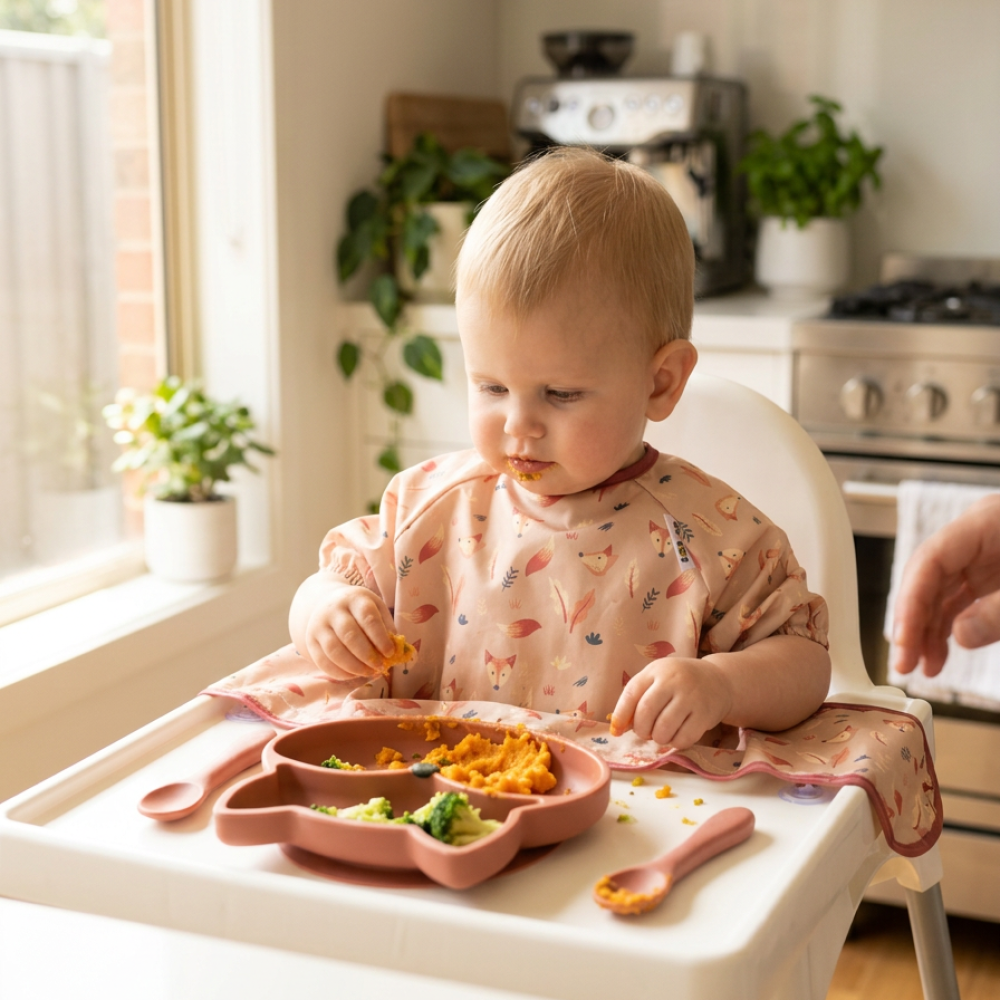
Ours Fox and Owl Silicone Cutlerya and Fox silicone plate they are made from certified European food-grade silicone - BPA-free, BPS-free, phthalate-free. The ergonomics are specifically designed for the small hands of babies starting solids.
If you are planning the first complete set, the Choo silicone meal set Includes plate, bowl, bib, and spoon in one collection — all with the same certification and soft color palette.
FSC-certified natural wood
Natural wood without synthetic varnish is another safe and ecological option. It is especially recommended for toys and initial nesting utensils, but less practical for plates and cups for obvious hygiene reasons.
Food-grade stainless steel (18/8 or 304 grade)
Excellent for cups and containers. It is BPA-free, does not absorb odors, and is virtually indestructible. The downside is the weight—for very small babies, silicone is generally more manageable.
Tempered glass
Safe and inert, but not very practical for active babies. Better suited for preparing purees than for toys the baby handles.
How to identify safe kitchenware when buying
Here’s a quick checklist:
- ✅ Explicit indication “BPA Free”, “BPS Free”, “Phthalates Free”
- ✅ European certification (CE) or food safety standards (EN 71, LFGB)
- ✅ Food-grade silicone or FSC-certified wood
- ✅ Brand with known origin — preferably European
- Avoid transparent or colored hard plastic without material indication
- ❌ Avoid products of unknown origin or without visible certification
- ❌ Never use plastic in the microwave — even if it's “BPA Free”
💡 Practical tip: When shopping online, always look for the product's technical data sheet. Reputable brands explicitly state the material and certifications. If this information is missing from the product page, it's a red flag.
What about cloth diapers and muslin cloths? Do they contain BPA too?
Cloth diapers — like the popular organic cotton muslin cloths — are generally BPA-free by nature, as they are made from natural fibers. What matters here is to check if the cotton is organic (pesticide-free) and if the dyes used are certified safe for babies (OEKO-TEX Standard 100 certification, for example).
In summary: BPA matters, but it doesn't need to scare you
BPA is a serious topic, but with correct information, it's entirely possible to equip your baby's kitchen with completely safe products. The market trend — especially in quality European brands — is precisely to move towards natural materials, food-grade silicone, and certified wood, which eliminate the problem at its root.
The simplest choice? Opt for certified food grade silicone for everything that goes into the baby's mouth and FSC wood for the toys. It's beautiful, durable, and you'll sleep more rested.
If you are in this phase of preparing for solid foods, also read our complete guide: Baby's Food Introduction: A Complete Guide for Parents.
Recommended products — BPA-free, Europe certified
- 🦊 Fox and Owl Silicone Cutlery — food-grade silicone, ergonomic, from 6 months
- 🦊 Fox silicone plate — with suction cup, stable on the table, easy to clean
- 🚂 Choo meal set in silicone — Complete set for starting solids
- 🦉 Complete Baby-Led Weaning Kit Owl all you need to get started
Frequently Asked Questions about BPA
Has BPA been banned in Europe?
In the European Union, BPA has been banned in baby bottles since 2011 and has been progressively restricted in other food-contact packaging. In 2023, EFSA (European Food Safety Authority) drastically reduced tolerable daily intake limits, signaling greater concern about its effects. However, a total ban on all products is not yet complete — hence the importance of always checking the labels on packaging.
How do I know if a product contains BPA?
Look for the “BPA Free” label on the packaging or in the product specifications. On older plastics, the recycling code “7” on the bottom of the container may indicate polycarbonate (which often contained BPA), but not all plastics with code 7 contain BPA. The safest option is to choose certified food-grade silicone or stainless steel for baby utensils.
Can I use old baby bottles if they are “BPA Free”?
If the bottle is relatively recent (manufactured after 2012 in the EU) and in good condition, it's likely safe. However, plastic bottles and utensils become scratched with use, and these scratches can harbor bacteria and increase the migration of substances. Regardless of BPA, it's recommended to replace damaged or heavily worn plastic utensils.
“Are ”BPA Free“ and ”food-grade silicone" the same thing?
No. “BPA Free” is a statement of absence of a specific compound, and can be applied to various materials—including plastics that replaced BPA with other bisphenols (BPS, BPF). Food-grade silicone is a different material from plastic, with a mineral base (silica), which is inherently free of BPA and related compounds. For baby utensils, certified food-grade silicone offers a greater guarantee of safety.
At what age should I worry about BPA-free utensils?
From day one. BPA exposure is concerning at all ages but especially critical in the first 3 years of life, when neurological and hormonal development is most intense. Baby bottles, pacifiers, teethers, plates, and cups—all objects the baby uses in contact with food or puts in their mouth should be BPA-free.
Do muslin swaddles contain BPA?
No, muslin cloth diapers do not contain BPA because they are made from natural fibers (cotton), not plastic. What's important to check with cloth diapers is the certification of the cotton (preferably organic) and the dyes used (OEKO-TEX Standard 100 certification).